

Over the next decade, a unique initiative will help equip Ghana’s youth with the practical skills and business savvy they need to transform the country’s nutrition, farming and food production.
Launched in summer 2025, the Nkabom Collaborative brings together McGill, six Ghanaian universities and the Association of Ghana Industries, in partnership with the Mastercard Foundation, to develop hands-on training, scholarships, mentorship and an entrepreneurial ecosystem that will open the door to fulfilling job opportunities for Ghanaian youth, especially people with disabilities, women, and marginalized communities, in the country’s agricultural and nutrition sectors.
The 10-year project aspires to create more than 30 new or improved academic programs, 5,000 bursaries, 3,000 youth-led agri-food ventures and 55,000 new jobs in Ghana – all aimed at empowering Ghana’s young people to address priorities in food security, climate adaptation and public health.
Nkabom means ‘togetherness’ or ‘unity’ in the Akan language and each partner in the Collaborative brings its own expertise to the effort.
McGill will play a key role in strengthening the capacity of Ghanaian universities to deliver hands-on training in sustainable agriculture and nutrition, one of the project’s main goals, and activities are quickly ramping up. The School of Continuing Studies now offers a free online project management course for Ghanaian students aged 18-35.
Meanwhile, McGill’s Sustainable Growth Initiative Office of Sustainable Africa is staging its inaugural Nkabom Africa Case Competition this semester, encouraging participants to come up with innovative ideas for improving nutritional outcomes in Ghana.
While some McGill-driven programs are offered remotely, others involve in-person collaboration. Notably, post-doctoral researchers from Ghana are expected to arrive at McGill this spring for two-year research positions in the Faculty of Agricultural and Environmental Sciences and the School of Population and Global Health, part of McGill’s train-the-trainer approach to supporting the development of new academic programs and enhancing research capacity.
“It’s a major project, it’s long term, and the best way to create trust and familiarity is by meeting face-to-face,” says Pierre Brunache Jr., director of the Nkabom Collaborative’s Secretariat, based at McGill.
We spoke to Brunache Jr., an international development specialist who lived and worked in Ghana for many years, about the ambitious project.
Q. What was the impetus for the Nkabom Collaborative and why focus on nutrition and the agri-food sectors?
There was an urgent need to address youth unemployment and underemployment in Ghana. We’re trying to bridge the gap between traditional academic theory and some of the practical needs in the agri-food and nutrition sectors.
Nutrition is very important because it’s reported that Ghanaians spend more than 40 percent of their income on food. The initiative will promote more nutrition-sensitive agriculture and growing diverse and nutrient-rich indigenous crops.
The agri-food system is at the front line of climate change. We’re aiming to introduce climate-smart practices to get youth involved in food production and also looking at the agricultural value chain – from farm to fork. It’s a way to reduce post-harvest losses to ensure enough food for the country. That’s why we chose those two sectors.
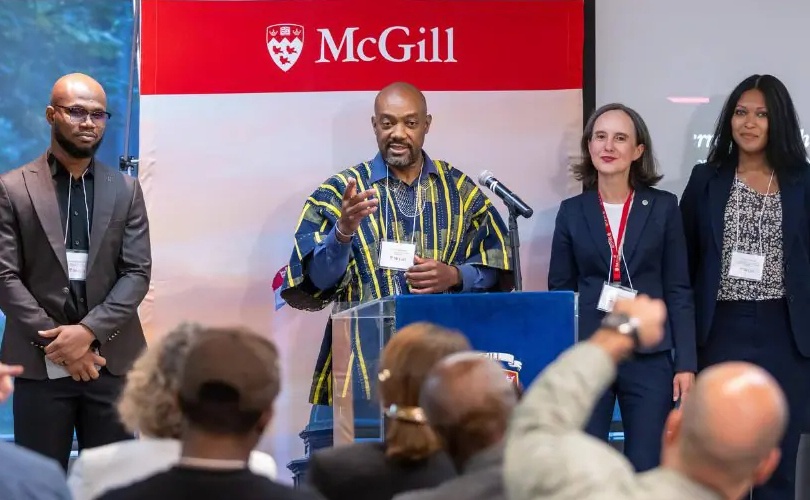
Pierre Brunache Jr. (centre) speaking at the McGill launch of the Nkabom Collaborative in August 2025
Are youth in Ghana still drawn to agriculture as a choice for work?
The youth are interested in smart agriculture – using agrotechnology, artificial intelligence and drones – as well as branding, packaging, congregating crops, greenhouses. But traditional agriculture? No, they’re not. They find the old practice of rain-fed agriculture too laborious. They see what’s going on in other countries – that’s what they want. And this is where this program is adding value.
How will this project help young people in Ghana create their own meaningful opportunities in the country’s nutrition and agri-food sectors?
I would say it’s the approach. Our Ghanaian partner universities are shifting to hands-on learning, which will appeal to youth and young women. Through experiential learning, they’ll be equipped with the business savvy, policy knowledge, and so forth – all the skills they need, as well as the network via our industry partners to scale and sell their products.
Where can McGill make its biggest contribution to the Nkabom Collaborative?
McGill’s role is all about institutional strengthening. The Mastercard Foundation is looking for us to strengthen our partner institutions in addition to serving as a secretariat for the Collaborative.
We’re proposing a lot of professional and hybrid skills training. When our partners visited McGill in November, there was quite a bit of interest from the School of Continuing Studies, the Faculty of Agricultural and Environmental Sciences, and McGill’s School of Population and Global Health to bring on board short courses in project management and data analytics, not just remotely, but also locally in Ghana to help train the youth.
McGill is supporting experiential learning and applied research across the Collaborative. One innovation we intend to bring is a nutritional map for Ghana. We’re going to collect data and show where there are nutritional deficiencies within the country, which will drive industry to fill those gaps. It will take the Faculty of Agricultural and Environmental Sciences, the School of Population and Global Health, and two of our local partners in Ghana to make this happen.
In 2034, when the project concludes, what does success look like?
How we transform the agri-food landscape. We have to find a way to tender this entire agri-food system to the youth. That means it’s youth-led, it’s high-tech, it’s using AI, it’s creating a good incubator for entrepreneurs, teaching them how to raise capital to keep going. Ensuring the workforce in 2034 is totally aligned with industry requirements.
We don’t want to just check boxes; it has to be impactful. If we can get those two done where we have a workforce from the universities in the nutrition and agri-food sector that is market-ready, along with investor-ready companies, to me, that’s success.