

Music will once again fill Pollack Concert Hall, McGill’s premier performance venue.
The Schulich School of Music’s largest concert space is reopening its doors after an extensive two-year renovation, thanks in large part to a generous gift from Dr. Constance V. Pathy, CM, LMus’71, LMus’86, DMus’15.
Located in the Constance V. Pathy Music Building – newly renamed in recognition of her support – the Hall will welcome music lovers back with a series of concerts and recitals starting in mid-September.
“This reopening marks a significant milestone for McGill and for Montreal's vibrant music scene,” says Deep Saini, the University’s President and Vice-Chancellor. “For decades, Pollack Concert Hall has brought audiences together to experience outstanding, accessible performances by musicians from Quebec, across Canada, and around the world, enriching the cultural fabric of our city. On behalf of McGill University, I extend our deepest gratitude to Constance V. Pathy and to every individual whose generosity made this renovation and reopening possible.”
The next chapter
At the Schulich School, Prof. Jean-Sébastien Vallée is excited to once again make the Pollack Concert Hall a central part of his musical life at McGill.
“We are getting a thoroughly renewed, accessible and technologically sophisticated concert hall, but we are retaining the acoustic identity that generations of McGill musicians have known,” says Vallée. “It is the best of Pollack’s history being carried forward into its next chapter.”
Vallée is an internationally recognized conductor and scholar, acclaimed for his expertise in vocal, choral, and orchestral repertoires. He is also a Professor of Music Performance, Director of Choral Studies, and Coordinator of the Ensembles and Conducting Area at McGill.
The Hall’s refurbishment, led by Les architectes fabg, includes 600 new seats, redesigned lighting and upgraded audiovisual systems. While carefully preserving the Hall’s renowned acoustics, the renovations refreshed its architectural finishes, interiors, lobby and East Lounge, creating a more welcoming experience for audiences.
Accessibility has been significantly enhanced for audience members and performers alike, with improved accommodations for people with reduced mobility, including wheelchair seating in a prime viewing area. The former centre aisle, which offers some of the best sightlines in the Hall, has also been filled with additional seating. Backstage and artist facilities have been redesigned to improve accessibility and functionality for performers and production teams, while theatrical lighting and audiovisual capabilities have been upgraded to modern standards.
“A great concert hall should be a place where everyone can participate, whether as a performer or as an audience member,” says Vallée. “The improved recording and broadcasting capabilities are particularly exciting. Today, the audience for a university concert hall isn’t limited to the people physically sitting in the room. Our performances can reach alumni, prospective students, families, colleagues, and music lovers around the world.”
In addition to hosting more than 300 concerts a year, the Hall plays a pivotal role in the education of students across a wide array of programs, serving as a venue for performance exams, and a training space for students in large ensembles such as the McGill Symphony Orchestra, Wind Orchestra, Contemporary Music Ensemble, as well as Opera McGill and Sound Recording programs. It also hosts a variety of University lectures and events; later this fall, the Hall will host McGill’s annual Beatty Lecture as part of Homecoming 2026.
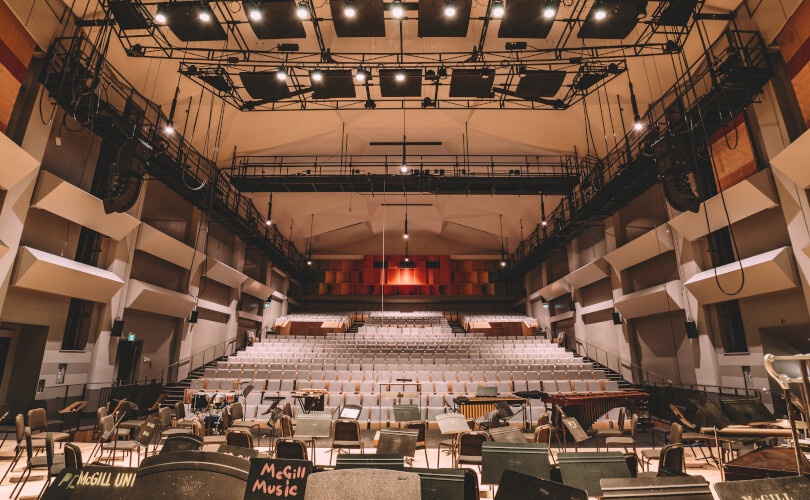
A view of the renovated Pollack Concert Hall.
Reopening spotlights percussion
The official relaunch of the Hall will take place on September 19 with a concert featuring Meagan Foster, MMus’26, a percussion soloist with the McGill Symphony Orchestra. Because the venue was shuttered during her two years of study, this will be Foster’s first opportunity to perform in the Hall.
“It’s very exciting to perform with a full orchestra because of how many people are involved,” says Foster. She will be performing Jennifer Higdon’s Percussion Concerto, the piece that won her the McGill Classical Concerto Competition in the Woodwinds, Brass and Percussion category earlier this year.
Foster and her fellow Schulich performers are sure to appreciate the Hall’s acoustics. “They have always been among the best in the country for classical music,” says Vallée. “A great acoustic becomes a teaching tool. It allows singers to hear differently, to develop greater sensitivity to balance, resonance, articulation, colour, and ensemble.”
Foster added that she plans to stay in Montreal to launch her music career. “It’s been a great two years and I’ve totally fallen in love with Montreal,” she says. “It’s such a wonderful place to be a musician.”
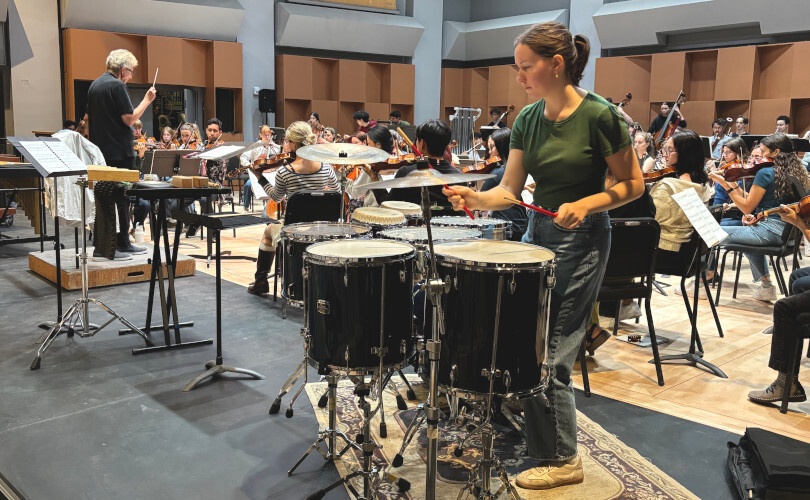
Meagan Foster rehearses with the McGill Symphony Orchestra in renovated Pollack Hall.
From student to patron
Dr. Pathy, a longstanding champion of Montreal’s arts and cultural community, made her anchor gift to the Pollack Concert Hall renovations in part as a tribute to McGill on the occasion of its bicentennial in 2021.
Her connection to Pollack Hall runs deep. Raised in a musical family, she began playing the cello at age 12. After moving to Montreal as a young adult, she joined the Ladies’ Morning Musical Club, Canada’s oldest continuously operating musical organization performing at Pollack Hall and later serving for many years as its president.
Fittingly, the club will launch its 135th season at the Hall later this month.
“Pollack Hall is a great asset for McGill,” she says. “I think it’s essential for Montreal. It’s the best hall of its size, and there are no bad seats for acoustics.”
A graduate of McGill’s Licentiate in Music performance program, where she studied cello and viola da gamba, Dr. Pathy has devoted decades to supporting classical music and dance in Quebec and beyond. Her many contributions to the arts include serving as president of the board of Les Grands Ballets Canadiens, chair of the Canadian Guild of Crafts, co-founding the celebrated McGill International String Quartet Academy, and helping establish the Schulich School of Music’s Faculty Advisory Board, on which she continues to serve.
“I spent half my life at McGill. I did not plan that, but it happened,” she jokes.
“The impact of Dr. Pathy’s leadership and vision as a patron of the arts and music in Canada is immense,” says Sean Ferguson, Dean of the Schulich School of Music. “For decades, her work has helped showcase extraordinary talent, and helped new musicians find their place in the world of performance and artistic creation. At McGill, she has reinforced the global reputation of the Schulich School through her wise counsel on our board and with her generous record of supporting our activities.”
Dr. Pathy has received many honours in recognition of her contributions to the arts, including the Order of Canada, the Order of Quebec, and the Order of Oranje-Nassau from the Netherlands, where she was born.
She is looking forward to the return of performances to Pollack Concert Hall and plans to attend concerts presented by the Ladies’ Morning Musical Club and Opera McGill, among others.
Her commitment to supporting the arts remains as strong as ever. “The arts are so important,” she says. “They greatly contribute to an enriched and fulfilling life.”
For details on the reopening of Pollack Concert Hall and the 2026-27 concert season, visit the Schulich School of Music website.